
What it is
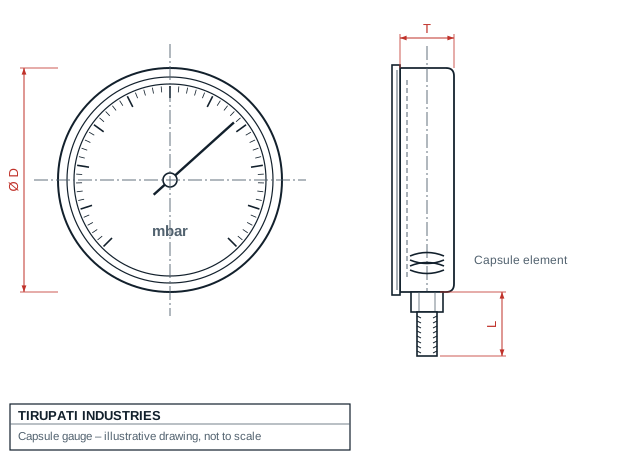
A capsule gauge has a sensing element made of two thin metal discs joined at the edge. It responds to very small pressure changes, far smaller than a Bourdon tube can show.
It is the usual choice for draft, furnace and ventilation readings.
How it works
Pressure inside the capsule makes it expand like a small bellows. The movement is magnified by a linkage and turns the pointer. Because the metal is thin, the gauge is sensitive, but it is also easy to damage with a sudden surge.
Where it is used
- Furnace and boiler draft
- Ventilation and air handling
- Low-pressure gas lines
- Medical and laboratory gas lines
Things to consider
- Use it only with air and non-corrosive gases.
- Protect it from sudden pressure surges.
- Choose a range close to the real working pressure, because the scale is very small.
What to tell us for a quote
- Gauge type and dial size
- Pressure range and unit (bar, kg/cm², psi, kPa)
- Connection type and size
- Material of the wetted parts (CS, SS or SS 316)
- The medium and its working temperature
- Quantity and any special need
Questions about compact capsule gauges
Can a capsule gauge measure liquids?
Capsule gauges are meant for air and clean dry gases. For liquids or aggressive media, a diaphragm or sealed diaphragm gauge is the better choice.
Need compact capsule gauges?
Send us the range, medium and connection and we will quote.