
What it is
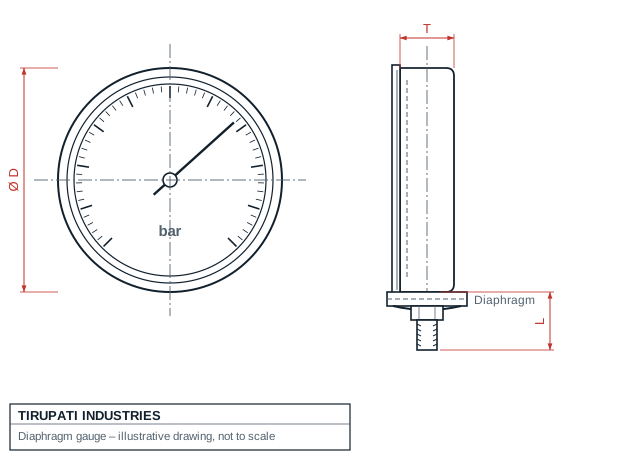
A diaphragm gauge senses pressure with a flat flexible diaphragm instead of a curved Bourdon tube. This suits low pressures that a tube cannot read well, and media that could clog or corrode a standard gauge.
The wetted parts are available in carbon steel, stainless steel and SS 316.
How it works
The process pressure acts on one side of the diaphragm and moves it slightly. A linkage turns that movement into the rotation of the pointer. Because the diaphragm is wide and flat, even a small pressure produces enough force to move the pointer smoothly.
Where it is used
- Low-pressure gas and air lines
- Filters and process equipment with small pressure changes
- Slightly corrosive or dirty media
- Boilers, burners and furnace lines
Things to consider
- Check that the diaphragm material suits the medium.
- Do not exceed the overpressure limit, because a flat diaphragm is easy to damage.
- Choose the dial size by where it will be read from.
What to tell us for a quote
- Gauge type and dial size
- Pressure range and unit (bar, kg/cm², psi, kPa)
- Connection type and size
- Material of the wetted parts (CS, SS or SS 316)
- The medium and its working temperature
- Quantity and any special need
Questions about diaphragm gauges
What is the difference between a diaphragm gauge and a sealed diaphragm gauge?
A diaphragm gauge uses the diaphragm itself as the sensing element. A sealed diaphragm gauge adds a separate diaphragm seal in front of a Bourdon-tube gauge to protect it from the medium.
Need diaphragm gauges?
Send us the range, medium and connection and we will quote.