
What it is
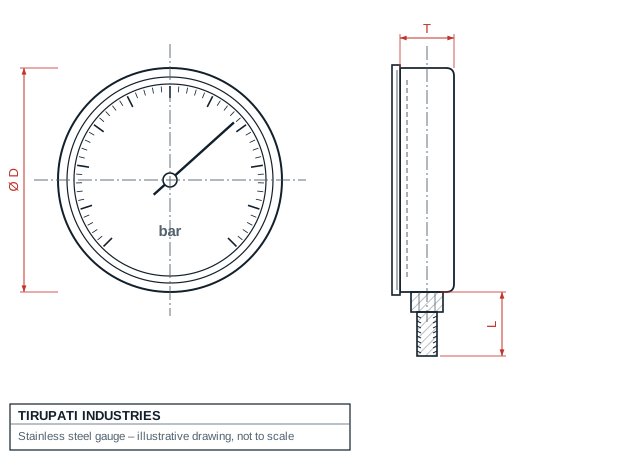
Stainless steel gauges have a stainless case and stainless wetted parts, so they resist rust and many chemicals. They are the usual choice for chemical plants, food and pharmaceutical areas, and coastal sites.
Available in SS and SS 316, and with a glycerine fill or in a clamp-type version.
How it works
The case and the parts that touch the medium are made of stainless steel instead of carbon steel or brass. SS 316 contains molybdenum, which improves resistance to chlorides and many acids.
Where it is used
- Chemical and petrochemical plants
- Food, dairy and pharmaceutical lines
- Marine and coastal sites
- Washdown and outdoor areas
Things to consider
- Check the medium against the material. SS 316 handles more media than standard SS, but not all.
- Choose a clamp-type connection for hygienic lines.
- Add a glycerine fill if there is vibration.
What to tell us for a quote
- Gauge type and dial size
- Pressure range and unit (bar, kg/cm², psi, kPa)
- Connection type and size
- Material of the wetted parts (CS, SS or SS 316)
- The medium and its working temperature
- Quantity and any special need
Questions about stainless steel gauges
What is the difference between SS and SS 316?
SS 316 contains molybdenum, which gives it better resistance to chlorides and many acids than standard stainless steel.
Need stainless steel gauges?
Send us the range, medium and connection and we will quote.